


Blog
A Day of Hospital Housekeeping: What Facility Heads in Bangalore Should Expect

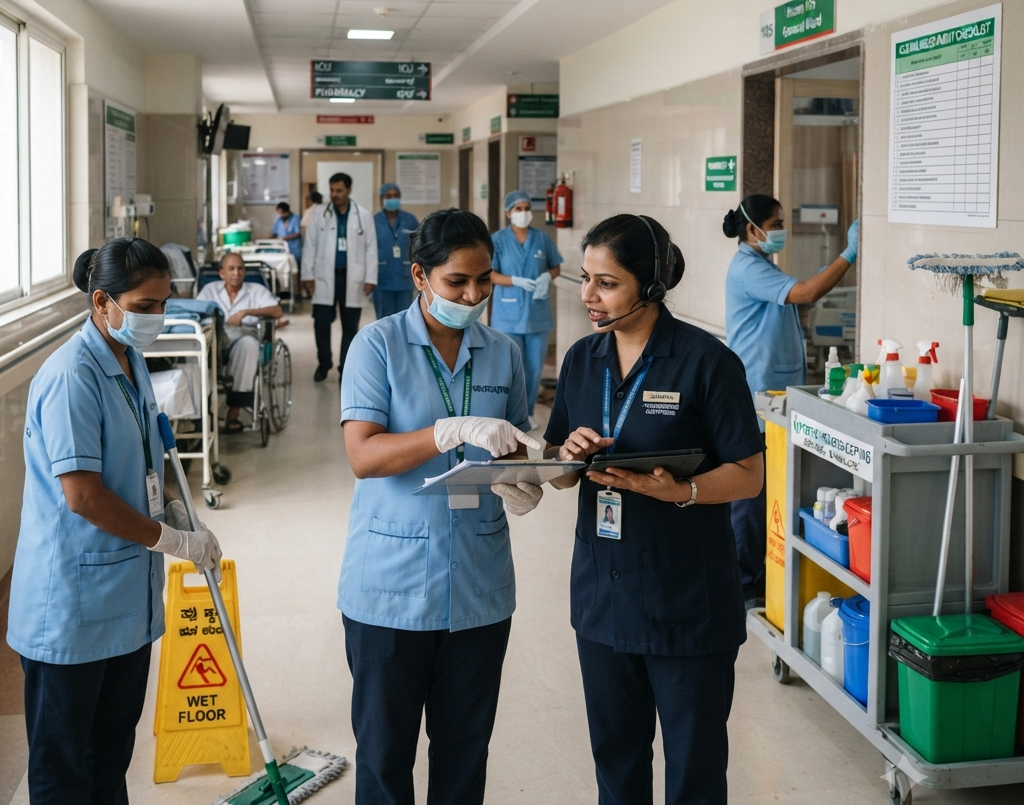
Hospital housekeeping services are easy to underestimate. From the waiting area, it looks like mopping and emptying bins. In reality, a hospital or clinic housekeeping team spends the day working around patients, following infection control routines, handling waste that falls under specific rules, and keeping public areas presentable for anxious families who notice everything.
The simplest way to understand what good healthcare housekeeping looks like is to follow a typical day. The timings below are illustrative. Every hospital sets its own schedule with its infection control team, but the rhythm is similar whether you run a large hospital on Bannerghatta Road, a nursing home in Malleswaram or a diagnostic centre in HSR Layout.
6:30 am: before the OPD opens
The early shift starts with the spaces patients see first. Entrances, the reception counter, waiting-area seating and public washrooms are cleaned before the first patients arrive. Lift buttons and handrails get attention because hundreds of hands will touch them by noon.
This is also when the team checks that every waste point has the right colour-coded bins and liners in place. In India, hospital waste is governed by the Bio-Medical Waste Management Rules, 2016, which require segregation at the point of generation into colour-coded categories. Clinical staff usually do the segregating. Housekeeping’s job is to make sure the right bins are there, collect bagged waste on schedule, and move it to the designated storage area.
9:00 am to 1:00 pm: the OPD rush
Once consultations begin, the waiting area and washrooms become the busiest spaces in the building. Washrooms may need checking every hour or two rather than twice a day. Spills are frequent and need quick, safe cleanup, with wet-floor signs in place so nobody slips.
In the wards, the housekeeping team works around care, not through it. That means coordinating with nurses about when a room can be cleaned, keeping trolleys out of corridors that staff and stretchers need, and paying close attention to the surfaces patients and visitors touch: bed rails, call buttons, door handles, tables and taps.
Midday: discharges and room turnover
Discharges often bunch up around midday. Each discharged bed needs thorough cleaning before the next patient can be admitted, and the hospital wants that done quickly. A housekeeping team that handles discharge cleaning well has a direct effect on how fast beds become available, which is why many facilities keep a dedicated person or small team for room turnover during this window.
When it rains
Bangalore’s monsoon adds its own work. Wet footwear and umbrellas turn entrance floors into slip hazards within minutes, so on rainy days the team puts down entrance mats, mops entrances far more often and keeps wet-floor signs out. For a hospital, where many visitors are elderly or unsteady, this is a safety issue rather than a cosmetic one.
Afternoon: the less visible work
Afternoons are when periodic tasks get done: corridor walls, high surfaces, behind furniture, pantry and cafeteria areas, staff rest rooms and administrative offices. For the office and admin side of the building, the routine is close to a normal workplace, and our office housekeeping checklist works well there.
Specialised areas such as operation theatres and ICUs follow the hospital’s own protocols and are cleaned only by staff trained for them, under supervision. A general housekeeper should never be sent into those spaces just because someone is short-staffed.
Evening visiting hours
When families arrive in the evening, washrooms, lifts and waiting areas fill up again. A second round of public-area cleaning keeps the building looking cared for at the time most relatives see it. Waste collection runs again so bags do not sit in corridors overnight.
Night shift
Many hospitals run around the clock, and so does housekeeping. The night team is smaller, but it handles emergency spills, late discharges, the casualty area and corridor floors that are easier to clean when traffic is low. It also hands over to the morning shift through a written log, so nothing is missed between teams.
What separates good hospital housekeeping from the rest
Following the day makes the difference clear. Good teams work to a written schedule agreed with infection control, not just “clean when it looks dirty”. They use separate, colour-coded equipment for washrooms, patient areas and pantries, so the same mop never moves from a toilet to a ward. They use only approved chemicals, as directed, and never mix products. They keep sign-off sheets that a supervisor or auditor can check. And they have relievers, so the routine does not collapse when someone is on leave.
Smaller clinics and nursing homes often miss exactly these points, usually because the person cleaning is a general helper rather than someone trained for healthcare settings.
If you are outsourcing, ask for these
| Ask for | Why it matters |
|---|---|
| Healthcare-specific training | Infection control basics, safe chemical use, waste-handling steps |
| A supervisor on each shift | Someone who coordinates with nursing and infection control |
| Area-wise logs | Proof of what was cleaned and when |
| PPE supplied and used | Staff safety around waste and spills |
| Background verification | Staff work in patient areas |
| Relievers and replacements | Coverage never drops |
Our article on 10 questions to ask before hiring a housekeeping service in Bangalore covers general vendor checks.
The front door matters too
Families judge a hospital in the first few minutes: getting the car parked, walking through the entrance, sitting in the waiting area, using the washroom. Housekeeping shapes most of that, alongside security and valet. If arrivals are a problem at your facility, our guide to hospital valet parking in Bangalore looks at the parking side.
Securmans provides trained, uniformed housekeeping staff for hospitals, clinics, diagnostic centres and nursing homes across Bangalore, working to your facility’s protocols with supervisors and relievers.
Common questions from facility heads
How is hospital housekeeping different from office cleaning?
The goal is infection prevention, not just appearance. That means area-specific routines, colour-coded equipment, waste-handling steps and staff trained to work safely around patients.
Who handles biomedical waste?
Clinical staff usually segregate it where it is generated. Housekeeping staff keep the right bins stocked and move bagged waste to the storage area, following the Bio-Medical Waste Management Rules, 2016 and the facility’s own procedures.
Can general housekeeping staff clean ICUs and operation theatres?
No. Only staff specifically trained for those areas, working to the hospital’s protocols and under supervision.
Do small clinics really need trained housekeeping staff?
Yes. A small clinic still sees a steady flow of patients and generates biomedical waste. Trained staff and a simple written schedule make a real difference.
How often should hospital washrooms be cleaned?
Public washrooms near the OPD often need checking every hour or two during peak hours. The exact frequency should be set with your infection control team and recorded on a sign-off sheet.
How many housekeeping staff does a hospital need?
It depends on beds, floors, OPD volume and how many shifts you run. Plan by area and by shift, and include relievers.
The short version
A well-run hospital housekeeping team is invisible when it works and obvious when it does not. Agree the schedule with infection control, insist on training and logs, keep relievers in place, and treat housekeeping as part of patient care rather than an afterthought.
If your hospital, clinic or diagnostic centre in Bangalore needs housekeeping support, contact Securmans or call +91 80695 78271.