


Blog
8-Hour vs 12-Hour Security Guard Shifts: How Many Guards Does 24×7 Coverage Really Need?

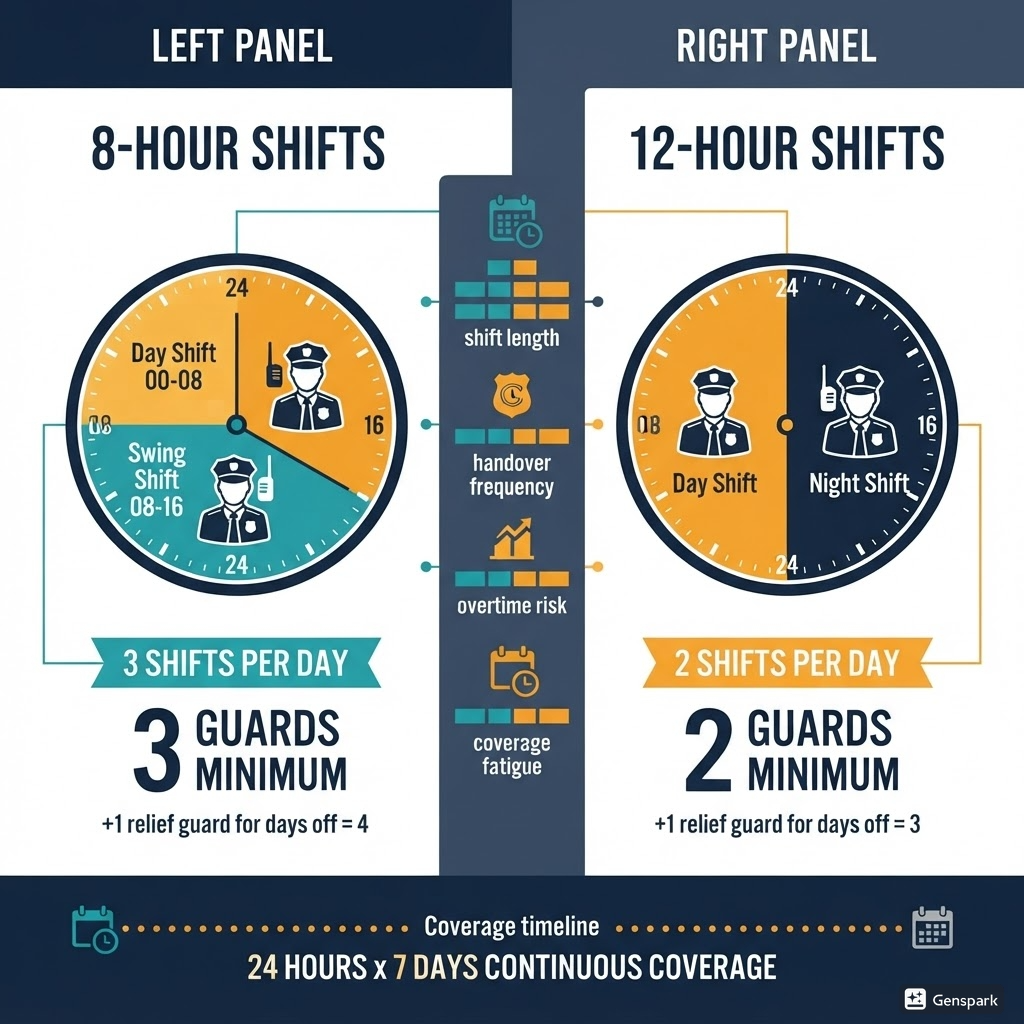
To keep one security post covered 24 hours a day, 7 days a week, you need more guards than most people expect. A single post runs for 168 hours a week. No one guard can or should cover that, so the real question is how those hours are split into shifts, and how many people it takes once weekly offs and leave are counted.
This is where many security quotes in Bangalore look different from each other. One agency quotes two guards for a gate, another quotes four. Both may be talking about the same gate. The difference is usually the shift pattern, and whether relievers are included.
This guide explains how 8-hour and 12-hour shifts work, the arithmetic behind round-the-clock coverage, and how to choose the right pattern for your apartment, office, factory or warehouse.
The Basic Arithmetic of a 24×7 Post
Start with one post, such as the main gate of an apartment complex:
- 24 hours a day × 7 days = 168 hours a week
- Indian labour rules commonly work around a standard week of about 48 working hours, with overtime paid beyond that
- 168 ÷ 48 = 3.5 guards for one post, before counting leave or absence
So in practice, a single post that must never be empty usually needs around four people on the roster, regardless of whether the shifts are 8 or 12 hours long. What changes is how those people are scheduled and how tired they are by the end of a shift.
If a quote shows only two guards for a 24×7 post, ask how weekly offs, leave and sick days will be covered. Often the answer is that the same two guards work long hours without a break, or the post is left empty on some days.
How 8-Hour Shifts Work
With 8-hour shifts, the day is divided into three shifts, for example:
- General / morning: 6 am to 2 pm
- Second / evening: 2 pm to 10 pm
- Night: 10 pm to 6 am
Three guards cover each day, and a fourth guard works as a reliever, covering weekly offs on a rotating basis.
Advantages of 8-hour shifts
- Better alertness. Shorter shifts are easier to stay attentive through, especially at night.
- Fewer overtime issues. Hours stay closer to standard working limits.
- Easier handovers at natural break points. Shift change happens at a time when activity is usually moderate.
- Lower fatigue-related risk. A guard at the end of an 8-hour shift is generally more reliable than one at the end of a 12-hour shift.
Drawbacks
- Three handovers a day. Each handover is a moment where information can be lost.
- Commuting at odd hours. Guards on the 10 pm and 6 am changes travel late at night or very early, which can be difficult in parts of Bangalore with limited public transport.
- More coordination for the agency’s supervisor.
How 12-Hour Shifts Work
With 12-hour shifts, the day is split into two:
- Day: 8 am to 8 pm
- Night: 8 pm to 8 am
Two guards cover each day, and relievers cover weekly offs.
Advantages of 12-hour shifts
- Only two handovers a day, which can mean more consistent information flow.
- Simpler for guards’ commutes, since shift changes fall at more convenient times.
- Common in the industry, so many guards are used to the pattern.
Drawbacks
- Fatigue. Twelve hours is a long time to stay alert, particularly on the night shift.
- Overtime and compliance. Long shifts across six days push hours well beyond a standard week. That has cost and legal implications that the agency, and you as the principal employer, should be clear about.
- Higher risk of “sleeping on duty” complaints, especially on quiet night shifts.
Side-by-Side Comparison
| Factor | 8-hour shifts | 12-hour shifts |
|---|---|---|
| Shifts per day | 3 | 2 |
| Handovers per day | 3 | 2 |
| Guards on duty per day (one post) | 3 | 2 |
| Typical roster with reliever | About 4 | 3 if each guard works long weeks; about 4 to stay near standard hours |
| Alertness | Generally better | Drops in the final hours |
| Overtime exposure | Lower | Higher |
| Commute timing | Some late/early changes | More convenient changes |
Which Pattern Suits Your Site?
There is no single right answer. Some general guidance:
- Apartments and gated communities: Gate activity peaks in the morning and evening. Many communities do well with 8-hour shifts at the main gate, especially at night, when alertness matters most.
- Offices and IT parks: If the office is busy only during business hours, consider a day pattern for reception and access control, with a smaller night team for patrols.
- Factories and warehouses: Match shifts to production or dispatch hours. If trucks move at night, the night shift needs your most alert people. Our guide to warehouse security guards in Bangalore covers gate procedures in detail.
- Construction sites: Night security usually matters more than daytime, when the site is busy with workers. See our article on construction site security guards.
Don’t Forget the Reliever
The reliever is the most commonly skipped line in a security quote. Without a reliever:
- Guards work without weekly offs, which leads to fatigue and attrition
- The post is left unattended on someone’s day off
- A different untrained person may be sent at short notice
Ask every agency how many relievers are included, how leave is covered, and how quickly a replacement reaches your site if a guard does not turn up.
Questions to Ask Before You Agree a Roster
- How many guards are on the roster for each post, including relievers?
- What are the shift timings, and who covers weekly offs?
- What is the policy on overtime and maximum hours per guard?
- How are night-shift guards checked by supervisors?
- How is information handed over at shift change: register, app, or verbal?
- What happens if a guard is absent?
You can also read our guides on how to hire the best security agency and hidden costs in security services in Bangalore, which explain how roster decisions affect your monthly bill.
How Securmans Plans Shifts
Securmans plans each deployment around the site rather than a fixed template. We look at entry points, peak hours, night risks and your budget, then recommend a shift pattern with relievers built in. Our security guard services cover apartments, offices, factories, warehouses and construction sites across Bangalore.
Frequently Asked Questions
How many security guards are needed for 24-hour coverage of one post?
Usually around four people on the roster: three guards on 8-hour shifts plus one reliever, or a 12-hour pattern with enough relievers to cover weekly offs and leave.
Are 12-hour shifts for security guards allowed?
Long shifts are common in the industry, but working hours, weekly offs and overtime must follow applicable labour laws. Ask your agency how it manages hours and overtime for each guard.
Which is better for night security, 8-hour or 12-hour shifts?
8-hour shifts generally keep guards more alert at night. If you use 12-hour shifts, regular supervisor checks become more important.
What is a reliever in security services?
A reliever is a guard who covers other guards’ weekly offs and leave, so the post is never left empty.
Why do security quotes differ so much for the same site?
Differences in shift pattern, the number of relievers, statutory payments and supervision usually explain the gap. Compare quotes line by line.
How should information be handed over between shifts?
Through a written or digital register that records incidents, visitors, pending tasks and keys, along with a brief verbal handover.
Final Word
Round-the-clock security is a scheduling problem as much as a staffing one. Work out the hours, include relievers, choose shift lengths that keep guards alert, and make sure handovers are recorded. That is what keeps a post covered every hour of every day.
To plan a security roster for your property in Bangalore, contact Securmans or call +91 80695 78271.